 Add to Chrome
 Add to Firefox
 Add to Edge
TokenFormer: Unify the Multi-Field and Sequential Recommendation Worlds
Apr 15, 2026
Recommender systems have historically developed along two largely independent paradigms: feature interaction models for modeling correlations among multi-field categorical features, and sequential models for capturing user behavior dynamics from historical interaction sequences. Although recent trends attempt to bridge these paradigms within shared backbones, we empirically reveal that naive unifying these two branches may lead to a failure mode of Sequential Collapse Propagation (SCP). That is, the interaction with those dimensionally ill non-sequence fields leads to the dimensional collapse of the sequence features. To overcome this challenge, we propose TokenFormer, a unified recommendation architecture with the following innovations. First, we introduce a Bottom-Full-Top-Sliding (BFTS) attention scheme, which applies full self-attention in the lower layers and shrinking-window sliding attention in the upper layers. Second, we introduce a Non-Linear Interaction Representation (NLIR) that applies one-sided non-linear multiplicative transformations to the hidden states. Extensive experiments on public benchmarks and Tencent's advertising platform demonstrate state-of-the-art performance, while detailed analysis confirm that TokenFormer significantly improves dimensional robustness and representation discriminability under unified modeling.

Flexible End-to-End Dialogue System for Knowledge Grounded Conversation
Sep 13, 2017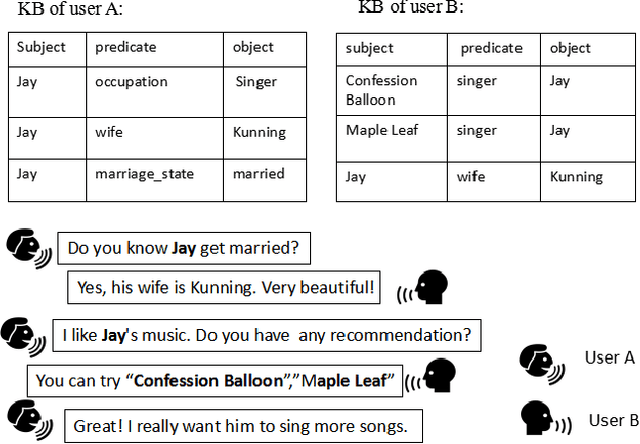
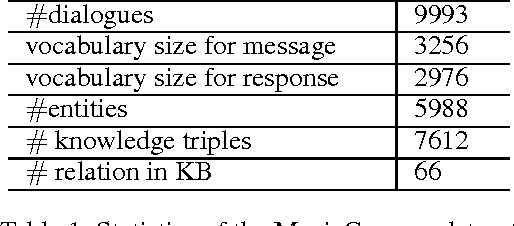
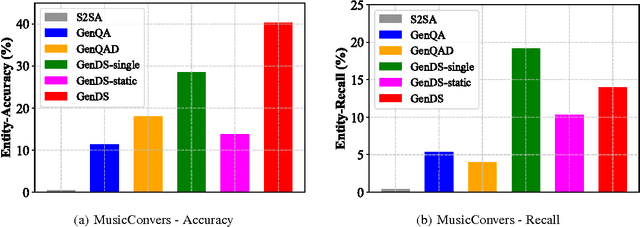
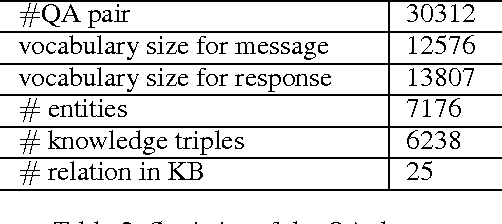
In knowledge grounded conversation, domain knowledge plays an important role in a special domain such as Music. The response of knowledge grounded conversation might contain multiple answer entities or no entity at all. Although existing generative question answering (QA) systems can be applied to knowledge grounded conversation, they either have at most one entity in a response or cannot deal with out-of-vocabulary entities. We propose a fully data-driven generative dialogue system GenDS that is capable of generating responses based on input message and related knowledge base (KB). To generate arbitrary number of answer entities even when these entities never appear in the training set, we design a dynamic knowledge enquirer which selects different answer entities at different positions in a single response, according to different local context. It does not rely on the representations of entities, enabling our model deal with out-of-vocabulary entities. We collect a human-human conversation data (ConversMusic) with knowledge annotations. The proposed method is evaluated on CoversMusic and a public question answering dataset. Our proposed GenDS system outperforms baseline methods significantly in terms of the BLEU, entity accuracy, entity recall and human evaluation. Moreover,the experiments also demonstrate that GenDS works better even on small datasets.